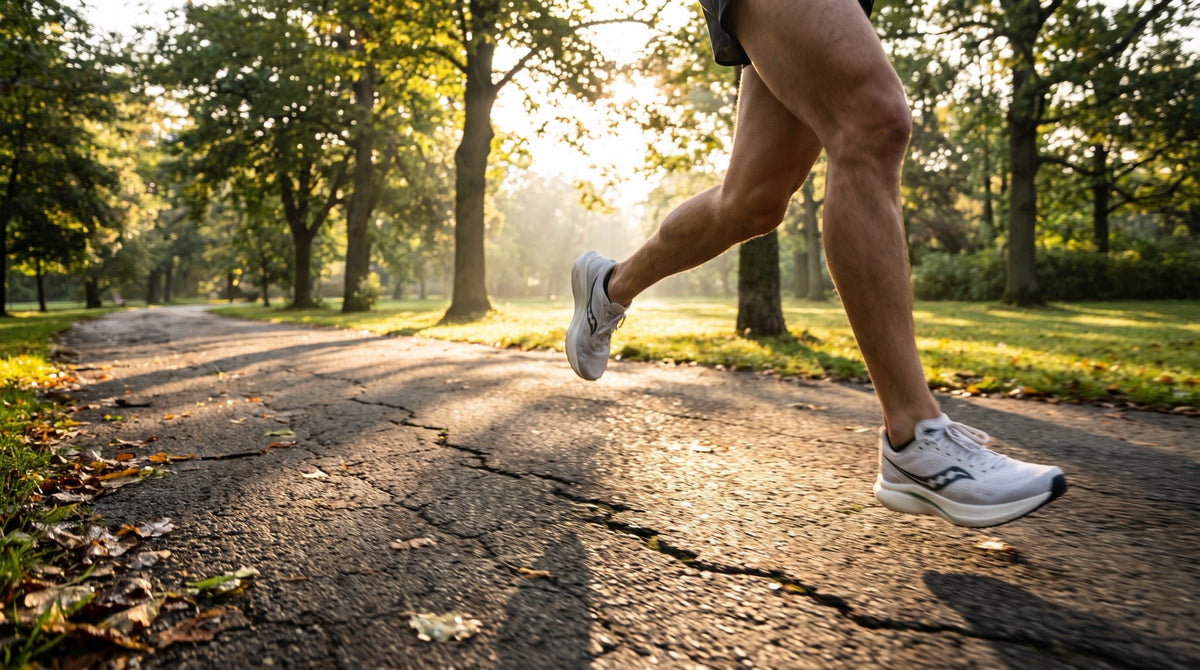
Whether it is an after-work run, interval training or a half marathon: blisters are among the most common minor complaints runners suffer from. They are rarely dangerous, but they can seriously disrupt a training session or a race. If you understand how blisters develop, you can take targeted steps to prevent them. In this guide you will find out what role shoes, socks, lacing and running technique play and how thin neoprene protection can relieve sensitive spots.
How do blisters develop when running?
With every step, your foot lands, rolls through and pushes off again. Pressure and shear forces act on the skin in the process. If the skin repeatedly shifts against the shoe or sock, the layers of skin separate and a fluid-filled blister forms. Heat and sweat intensify the effect because moist skin is softer.
Commonly affected areas are:
- Heel: when the shoe is too wide at the back or the heel lifts during push-off
- Toes and tips of the toes: when the shoe is too short at the front or the foot slides forward downhill
- Ball of the foot: with a lot of forefoot loading, for example during fast sessions
- Inside of the foot and ankle: at seams, edges or pressure points in the upper
Running shoe and fit
A running shoe should hold your heel securely, fit snugly around the midfoot and leave enough room for your toes at the front. Many runners choose running shoes slightly larger than their everyday shoes because the foot gains volume under load and in warm conditions. So try on running shoes with your running socks and, if possible, in the afternoon.
You should introduce new running shoes gradually: first on short, easy runs, then on longer distances. Choosing an unworn pair right before a race in particular is not a good idea.
Socks, lacing and skin care
- Technical socks instead of cotton: Socks made of synthetic technical fibres wick moisture away from the skin and keep their shape. Cotton soaks up moisture and is more likely to form creases.
- The right sock size: Socks that are too large form creases, socks that are too small pull at the toes.
- Adjust the lacing: The lacing should secure the foot at the midfoot without constricting the toes. If your heel slips, firmer lacing at the top can help.
- Keep your feet dry: After wet runs, let your shoes and insoles dry thoroughly, but not on the radiator.
- Keep your toenails short: Long nails press against the toe box and can encourage blisters under the nail or on the tips of the toes.
- Increase your mileage slowly: Longer distances put more strain on the skin. Increasing your mileage gradually gives your skin and feet time to adapt.
Neoprene protection directly on the skin
If you keep getting blisters in the same places despite good shoes, you can give your skin extra protection. Besides tape and plasters, there is a solution many runners do not think of: a thin neoprene sock worn directly on the skin under the running sock.
The Ankle Booties consist of a neoprene sock with almost seamless construction. They are worn on bare skin and simply pulled on under your normal sports sock. According to the product description, two thicknesses are particularly suitable for runners:
| Thickness | Who it is for according to the product text | Note for runners |
|---|---|---|
| 1 mm | athletes who need direct contact with the shoe, e.g. sprinters | very thin, hardly changes the fit of the running shoe |
| 2 mm | ambitious athletes with more severe blisters and chafing, e.g. joggers | more protection, needs a little more room in the shoe |
Whether 1 or 2 mm is the better fit depends on how much room your running shoe offers and how severe your problems are. We compare the thicknesses in detail in the guide Ankle Booties: 1, 2 or 3 mm?
Blisters on the toes
Ankle Booties protect the heel, ankle and midfoot. For the toe area there are the Toe Booties. They are made of ultra-thin 1 mm neoprene with a separately stitched big toe. They too are worn on bare skin under the sock and can be combined with Ankle Booties. They are washed by hand with a mild detergent. You will find more on this topic in the article Avoiding blisters on the toes.
In training and in races
Test every change to your equipment in training first: new socks, a different shoe or neoprene protection. Whatever works well on an easy ten-kilometre run can then be tested on longer sessions. On race day you should only use equipment you already know.
While running, watch out for the first warning signs such as burning or a hot spot. A short break to smooth out your sock or correct your lacing often prevents worse.
If the blister is already there
If possible, do not pierce blisters, as the skin over them protects against dirt. A blister plaster relieves the pressure on the spot. Give your skin a few days' rest or choose sessions that do not irritate the spot. For open, inflamed or recurring spots, please seek medical advice.
Do you have questions about the right size or thickness? Call us on +49 (0) 77 20 / 34 70 6 or write to us using the contact form. We will also be happy to advise you in person in our shop in Villingen-Schwenningen.