Cross-country skiing and ski touring are endurance sports done in a stiff boot. With every step, every push-off and every kick turn, your foot is working inside the boot. If you get blisters on your heel or ankle, you often have to end the tour earlier than planned. In this guide you can read why blisters develop especially on the ascent and in classic cross-country skiing, how you can prevent them with fit, socks and lacing, and how thin neoprene protection worn on the skin can relieve sensitive spots.
Why blisters develop in cross-country and touring boots
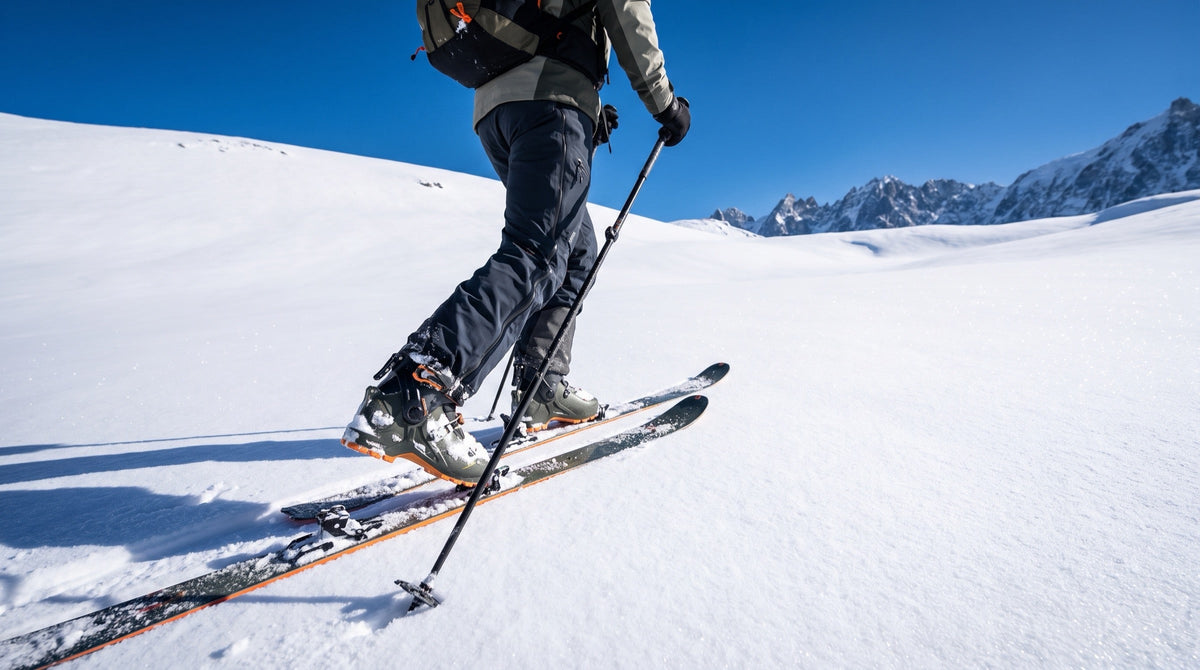
When ski touring, your heel lifts off the binding with every step on the ascent. If your foot does not sit firmly in the boot, the heel slides up and down and rubs against the shell or the liner. It is similar in classic cross-country skiing: the foot rolls through in the soft boot and the heel moves. In skating technique, on the other hand, stronger lateral forces act on the ankle and the inside of the foot.
On top of that come typical winter sports conditions:
- Sweat on the ascent: Your feet sweat under exertion, even when it is cold outside. Moist skin is more sensitive.
- Long tours: Many hours in the boot mean thousands of movements at the same spots.
- New or rarely worn boots: The liner and shell have not yet adapted to your foot.
- Rental boots: They often fit only approximately and are too wide or too tight in places.
- Thick socks: Wearing socks that are too thick to fight cold feet changes the fit and risks creases and pressure points.
Fit and lacing
A cross-country or touring boot should hold your heel firmly. A simple test helps when trying boots on: bend your knees and lift your heel. If it slides up noticeably in the boot, the boot is too wide at the back. Your toes should not touch the front, but should not have much room either.
- Set your heel back: Tap your heel lightly into the heel counter before closing the boot.
- Close the shaft and instep well: A firm fit over the instep keeps your heel down.
- Do not constrict the forefoot: Buckles or lacing that are too tight at the front can cause pressure points and cold toes.
- Readjust: After the first warm-up, the material often gives a little. Check the closures again after a while.
- Switch for the descent: With touring boots, the buckles and walk mode change between ascent and descent. Make sure your foot sits securely in both settings.
The right socks
For cross-country skiing and ski touring, thin to medium technical or wool socks that wick away moisture and fit smoothly are suitable. They should reach above the shaft of the boot so that no edge rubs against your leg. On multi-day tours, a dry spare pair is worthwhile.
Neoprene protection for heel and ankle
If you keep getting blisters on your heel or ankle despite a good fit, you can protect your skin with a thin neoprene sock. It is worn directly on bare skin under your normal sock. The friction then occurs between the neoprene and the sock and no longer directly on your skin.
The product description of the Ankle Bootie SKIN explicitly mentions cross-country skiers and ski tourers, as well as speed skaters and hikers. It is made of super-stretch neoprene with bonded Lycra, feels slightly thicker and softer and offers more padding than the classic black 1 mm Ankle Booties. The SKIN is only available in 1 mm thickness, in sizes XS to XL.
The classic Ankle Booties are available in 1, 2 and 3 mm. For cross-country skiers, the product text names the 2 mm and 3 mm thicknesses:
| Model | Thickness | When it makes sense |
|---|---|---|
| Ankle Bootie SKIN | 1 mm | tight boot, little room, preference for soft, close-fitting material |
| Ankle Booties | 2 mm | ambitious athletes with more severe blisters and chafing, e.g. cross-country skiers |
| Ankle Booties | 3 mm | loose or ill-fitting boots with severe problems, e.g. for cross-country skiers and hikers; not available in XL (up to L, 41–44) |
The thicker the protection, the more the fit changes. In a tight-fitting touring boot a thin version is usually more comfortable; in a rental boot that is too wide, a thicker version can give your foot extra stability. Our guide Ankle Booties: 1, 2 or 3 mm? helps you decide. Try the protection with your boots before your first big tour.
On tour: take warning signs seriously
A burning sensation or a warm spot on your heel is an early signal. Stop as soon as you feel it, even if taking off your boot in the cold is a nuisance. Often it is enough to smooth out the sock, adjust the buckles or cover the spot with a plaster. If you carry on to the next hut, you usually already have the blister.
By the way: if you train for the winter during the summer, you will find ideas in the article Skike and off-road skating. The same applies there: well-fitting shoes and socks prevent chafing.
If the blister is already there
If possible, do not pierce the blister and protect it with a blister plaster. Relieve the pressure on the spot until the skin has healed. For open, inflamed or recurring spots, please seek medical advice.
Would you like to know which size or thickness suits your cross-country or touring boots? Call us on +49 (0) 77 20 / 34 70 6 or write to us using the contact form. We will also be happy to advise you in our shop in Villingen-Schwenningen.